Electrical panel upgrade, done to code and built to last.
Upgrading from a 100A fuse box or undersized breaker panel in Palm Beach County gives your home the capacity for modern living — EV charging, whole-home generators, solar, and the peace of mind that comes from a permitted, licensed install that passes inspection the first time.
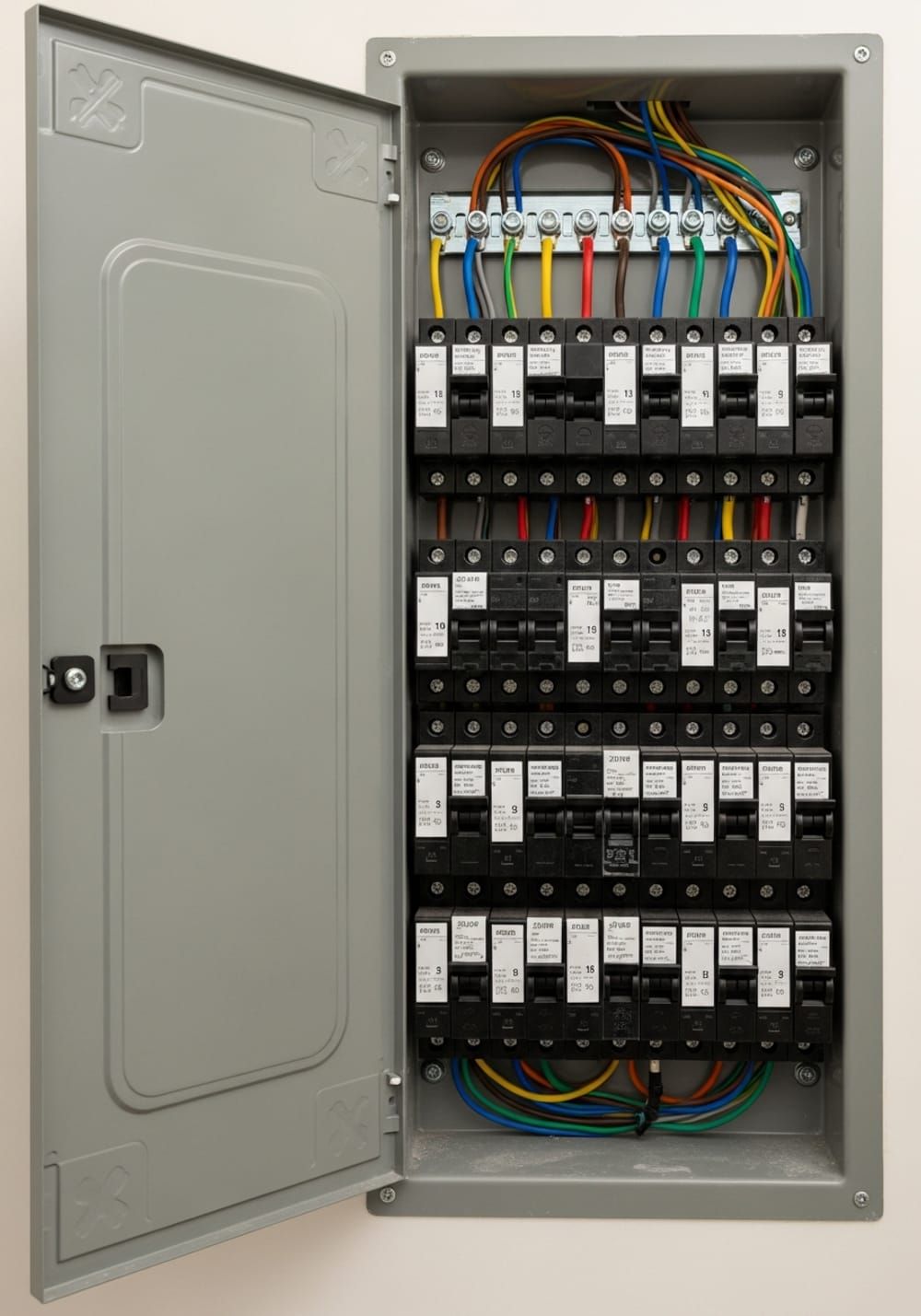
A panel upgrade is a one-time chance to get the electrical service right
When you are weighing an electrical panel upgrade or panel replacement in Palm Beach County, you are almost certainly living with a system that was designed for a smaller electrical load than your household demands today. A 100A fuse box or an aging 100A breaker panel that made sense in 1975 is not sized for dual-zone HVAC, an EV charger, a modern kitchen, and a whole-home generator — all of which are increasingly standard in Palm Beach County homes. Replacing the panel is the moment to fix the whole service at once: the amperage, the breaker types, and the dedicated circuits your family actually uses.
That one-time nature is why getting the sizing right matters so much. Upgrading to 200A today when you know an EV charger is coming next year costs far less than upgrading twice. We run a proper load calculation on-site — factoring in your current appliances, your planned additions, and any solar or battery backup equipment — and size the panel to your real demand, not the minimum that passes today’s inspection.
A note on credentials: every panel replacement in Palm Beach County is a permitted job performed by a licensed Florida electrical contractor. The permit triggers a county building inspection that is not optional and not a formality — it is the check that confirms the work is safe, that your homeowners insurance is valid, and that the documentation is clean for your next home sale. We pull the permit, call in the inspection, and make sure the work passes.
When your panel is no longer enough
You rarely need every box checked — two or three of these usually mean a panel upgrade is the right call, especially before adding an EV charger or generator.
Breakers tripping without a clear cause
Breakers that trip under normal loads — not during a surge or appliance fault — are a sign the panel is running near or over its rated capacity.
Fuse box still in service
Fuse panels — especially Federal Pacific Stab-Lok and Zinsco panels — are known failure points and are often flagged by insurers, home inspectors, and appraisers as uninsurable.
Lights dim when appliances run
A visible voltage drop when the AC kicks on or the dryer runs indicates the panel is being pushed to its limit — a safety issue and a sign the service is undersized.
No room for new circuits
A full panel with no open slots is not just inconvenient — adding a tandem breaker or doubling up is a code violation. EV chargers and generators need dedicated circuits.
Planning an EV charger or solar
A Level 2 EV charger needs a dedicated 50–60A circuit. A solar + battery system adds load calculations most 100A panels cannot accommodate without an upgrade.
Insurer or inspector pressure
In Florida, an aging or non-code-compliant panel can trigger a policy exclusion or non-renewal. A permitted, licensed upgrade resolves the flag and documents the compliance.
Choosing the right service size
The panel amperage determines what your home can run simultaneously. Bigger is not always better — what matters is matching the service to your actual and planned load.
| 100A (older standard) | 200A (modern standard) | 400A (large home / EV+solar) | |
|---|---|---|---|
| Best for | Small homes, basic loads only | Most Palm Beach County homes | Large homes, EV + solar + generator |
| EV Level 2 charger | Often not feasible | Yes — dedicated 50–60A circuit | Yes — multiple chargers possible |
| Whole-home generator / solar | Limited, load-shed only | Yes (with load calculation) | Yes — full critical + comfort loads |
| Relative cost | $ (legacy) | $$ (most common upgrade) | $$$ |
| Permit + inspection | Required | Required | Required |
Not sure which size is right for your home? Our electrical cost estimator walks you through the key inputs — home size, current appliances, and planned additions — and gives you a ballpark range before you call.

A panel upgrade you can finally stop thinking about
The night the panel is replaced, the lights stop dimming, the breakers stop tripping, and the EV charger you have been putting off becomes a same-week install. The panel is the one part of your home’s electrical system that touches everything — getting it right once, under permit, with a licensed contractor who runs the numbers, is the upgrade that pays off every month for the next 30 years.
Panel upgrades in Palm Beach County: what to know
Wondering what a panel upgrade costs for your home? Use our free estimator — enter your home size, service goals, and planned additions for a ballpark before you call.
Try the Panel Cost EstimatorWhat a code-right panel upgrade actually involves here
An electrical panel replacement in Palm Beach County is a permitted job governed by the Florida Building Code and the adopted NEC. Knowing the rules before the job starts is what separates a panel that passes inspection and keeps your insurance valid from one that does not.
How a Palm Beach panel upgrade actually goes
It starts with an on-site evaluation — not a sales pitch. We inspect the current panel, meter, and weatherhead, photograph what we find, run the load calculation, and give you a straight recommendation: the service size you need, the circuits to add, and any code upgrades (AFCI, GFCI) the inspection will require. Then we give you a written price before any work begins.
Once you approve, we pull the permit and schedule the job. The utility disconnects the service at the meter for the install day. We remove the old panel — whether that’s a fuse box, a Federal Pacific Stab-Lok, a Zinsco, or an undersized breaker panel — and install the new service: new panel, new main breaker sized to the service amperage, new service entrance conductors if needed, new AFCI and GFCI breakers for the circuits that require them, and the interlock or sub-panel feeds for your generator or EV charger.
Most 100 → 200A upgrades are completed in a single day, power-off to power-on, with the building inspection scheduled for the same week. We call in the inspection, meet the inspector, and close the permit. You get a copy of the closed permit and the documentation your insurer will ask to see. If you are planning an EV charger or generator install next, we rough in those circuits on the same job — the permit is already open.
What an electrical panel upgrade costs in Palm Beach County
There is no honest flat price for a panel upgrade — the cost depends on your current service size, the service size you are upgrading to, the condition of the meter and weatherhead, whether your wiring needs updates to meet current code (AFCI, GFCI), and the number of dedicated circuits your planned additions require. A straightforward 100 → 200A upgrade in a house with a clean meter base costs less than a 400A upgrade with a sub-panel, generator interlock, and EV charger pre-wire. We quote on-site after the load calculation and give you an itemized written price, so you know exactly where every dollar goes.
The fastest way to a ballpark before you call: use our electrical panel cost estimator — enter your home size, current service, and what you are planning to add, and it walks you through the main cost drivers with a realistic range. Then book a free, no-pressure on-site estimate for the exact number.
Replacing your panel: common questions
How much does an electrical panel upgrade cost in Palm Beach County?
How do I know if I need a panel upgrade?
Do I need a permit to replace my electrical panel in Florida?
Can a panel upgrade support an EV charger or solar system?
What is the difference between a 100A and 200A electrical panel?
Ready for a panel upgrade? Get a free on-site estimate.
A licensed electrician inspects your current panel, runs the load calculation for your actual usage and planned additions, and lays out cost and timing with a firm written price. No pressure, no call center.